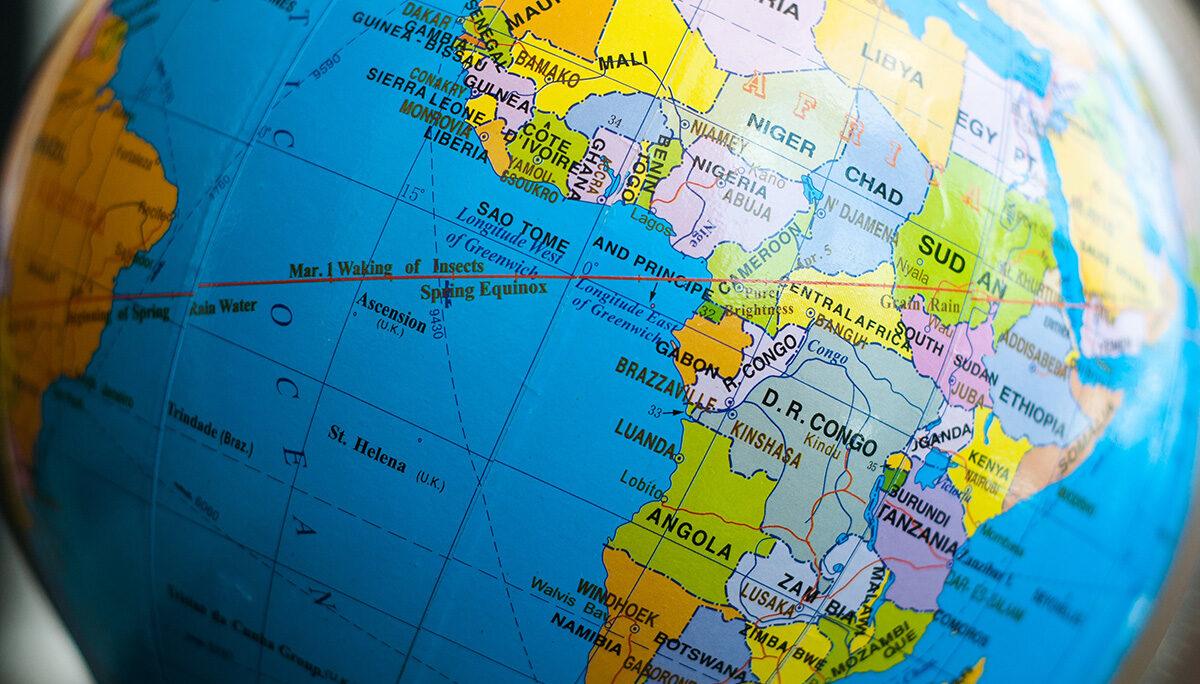
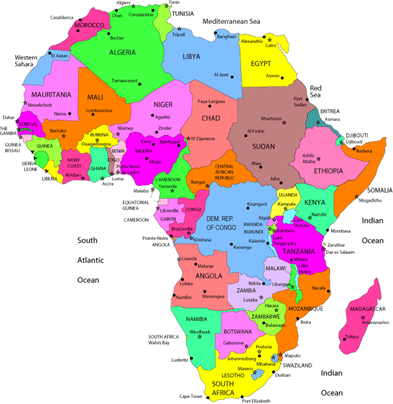
The continent of Africa is 2 ½ times the size of Europe. It is larger in land area than North America. It contains 54 countries and more than 1.2 billion people who belong to more than 3,000 different ethnic groups and speak English, French, Moroccan, Xhosa, Swahili, Bantu and 2,000 other languages…a Tower of Babel, indeed. It is too big to ignore!
Africa is likely home to man’s beginnings…the place where he first stood upright, first discovered fire. The world’s first mega-culture, Egypt, began there 5,000 years ago, when their ancestors tamed the Nile River and built a civilization that lasted 3 millennia. The Mali empire, with Timbuktu as its cultural center, held sway for nearly200 years around the 14th century.
But mostly, Africa deserves its acronym, The Dark Continent. Throughout history, except for the odd missionary or explorer, Europeans limited their involvement with Africa to the coasts where opportunities for trade were plentiful. It was where their ships could resupply on the way to India and China.
In the 16th century Portuguese trading ships discovered a new, lucrative trade…slaves, and so began a terrible 300 years in world history…more than 12 million West Africans, shackled, and chained, were crowded into the hulls of ships. 10 million were brought to America.
By the middle of the 19th century European countries wanted a piece of this new, unexplored land they could plunder. The more colonies a country had, the bigger player they’d be on the world stage. In 1895 a conference of 14 countries was held in Berlin where large parts of Africa were divided up. In the end, Britain, France, Germany and 4 other countries carved the continent between them. It would pretty much remain that way through World War II when uprisings across the globe threw off the yoke of colonialism with wars of independence. Colonies such as Northern and Southern Rhodesia became Zambia and Zimbabwe. German West Africa became Namibia. Uganda’s independence led to dictatorial rule by Idi Amin. Zimbabwe, a fertile, prosperous country, suffered economic collapse when Robert Mugabe forced all whites out of the country.
Drought, AIDS, wars, genocides, and economic strife have plagued most of the continent since then. Along the Mediterranean, Morocco thrived while Libya was run by the dictator, Gaddafi, and Egypt by Nasser. France, unwilling to give up Algeria, relented after an 8-year-long Civil war that killed hundreds of thousands. At the Southern tip, Apartheid’s white-only policies held South Africa in an iron grip until 1990 when Nelson Mandela’s rainbow-coalition attempted to build a racially neutral democracy.
Which brings us to today. There are 54 stories as each country faces its own challenges. They can’t compete with more developed parts of the world. They don’t have technology, health systems, education, or infrastructure. The recent Covid pandemic illustrated how susceptible they could be.
The Sahara Desert has been expanding as a result of a warming planet. Agricultural areas that fed so many are now dry and abandoned. Two years ago, Cape Town, South Africa, a city of nearly 5 million, ran out of water. That country now faces frequent brownouts. Radical groups flourish in the Congo and elsewhere, training young boys to be soldiers. Girls are stolen and held hostage. Governments are too weak or corrupt to respond.
Africa really is too large to ignore. We must do better!