Huge numbers of immigrants are poised on our southern border, anxious to enter the United States in search of a better life, hoping to leave behind violence, lawlessness, and radical changes in weather patterns that have made farming impossible. As a country we are unprepared, both financially and culturally, to assimilate them.
America isn’t alone in this dilemma, and to better understand the issues we need to consider a more global perspective.
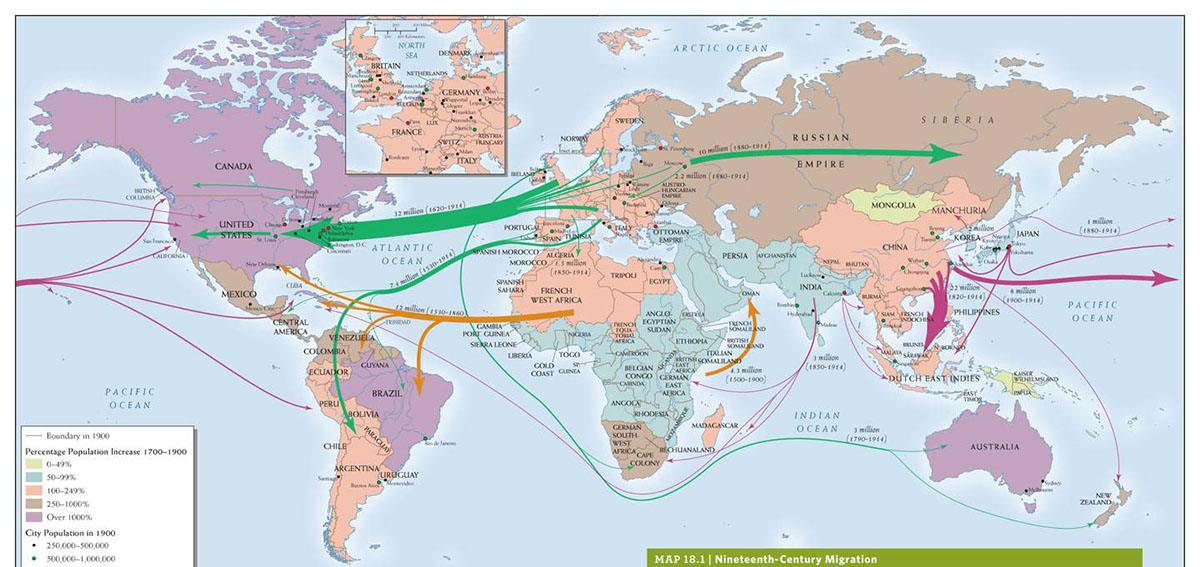
Populations move! They always have and they always will. People will risk everything in the hope that over that next hill will be something ‘better’…a safer life in which to raise their children. Huge swaths of people migrated to the United States, initially to escape religious persecution, and later from Germany, Ireland, and Eastern Europe to escape unrest and famine. A century ago Ellis Island processed more than 12 million immigrants. Earlier we had imported nearly ½ million Africans as slaves.
This movement of large numbers of people raises two issues. First, absorbing the sheer number of people wanting to relocate, and second, the assimilation of those people who often lack language skills, are often uneducated, and are often ethnically and religiously different. The United States has done a far better job in this regard than other countries where enclaves of first generation immigrants remain isolated for generations.
In Europe, where the population was historically white, things have been changing as well, partially due to a declining birthrate. For a population to be stable, women must bear 2.1-2.2 children, but as women have become more educated, and it has become more expensive to support large families, Europe’s birth rate has dropped well below 1.5. This creates an aging population, a smaller work force, and a reduced ability to fund programs for the elderly.
Germany tried to solve its labor shortage by importing large numbers of Turkish workers and, in 2015, additionally opened their doors to more than one million Syrian refugees who were neither white nor Christian. Meanwhile, France was struggling to absorb those wanting to escape from their decades long conflict in Algeria. Together with immigration of non-Europeans, France’s non-white population has ballooned to 9%…nearly 20x the rest of the continent. Their ability to integrate them into the French mainstream has been dismal.
The United Kingdom had always had open doors to its colonies. Huge numbers of Indians, Pakistanis, South Africans, Kenyans, and Jamaicans crowd English neighborhoods, altering language and living patterns. Who could have predicted that Winston Churchill would be followed less than a century later by an Indian-descended Prime Minister, Rishi Sunak, whose parents had immigrated from East Africa in the 1960s.
The population of the United States exceeds 300 million. Like the rest of the Western world, it is aging. Birth rates are declining. Technology has raised the standard of living…we produce more food per acre than in the past. We can manufacture more goods with less labor…all good. Except that such progress exacerbates the gaps in education and wealth.
It is easy to identify the issues. It is difficult to find solutions. Our attention span has shrunk The American political system fails in its ability to establish long-term programs. A 2-year term for Congress, for example, has Representatives raising funds for re-election even before they are sworn in.
Immigration requires a societal long term solution. It will continue, and, as it has since we became a nation, provide our country with energetic, talented people. We have always put out a sign that says “Welcome!” That’s who we are.