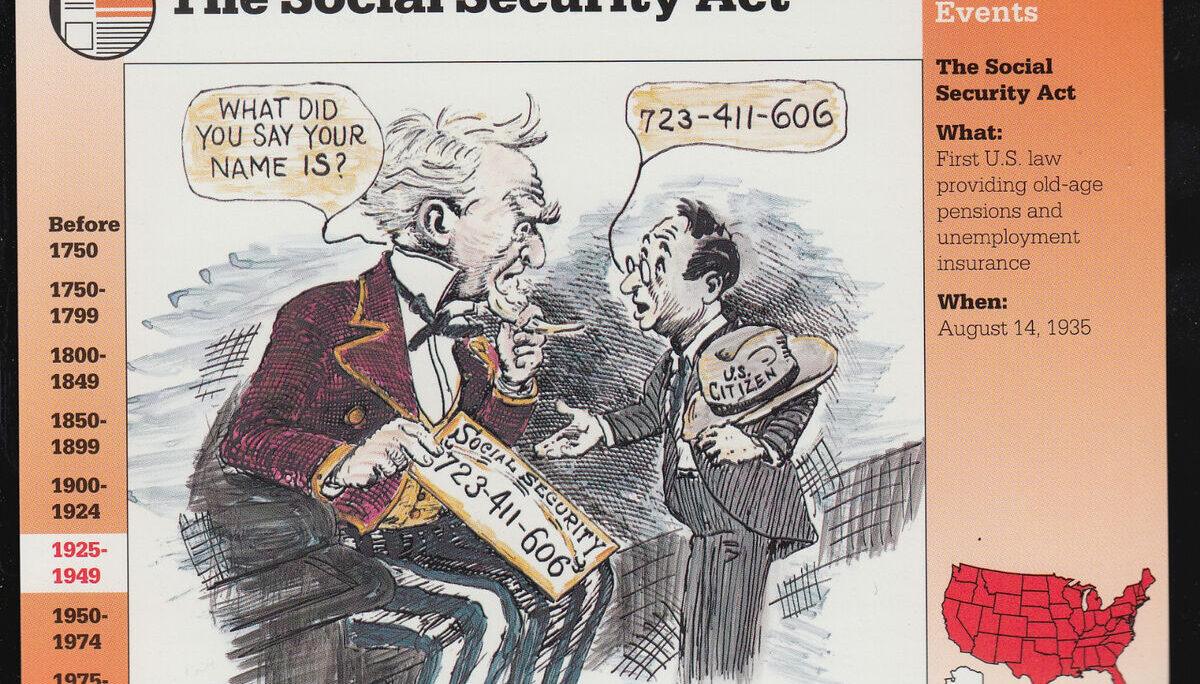
Social Security was never intended to FINANCE us in our ‘golden’ years…it was intended to SUPPLEMENT our retirement income…to provide a safety net. But in almost ninety years since its passage, the world has become a far different place.
In 1935 the United States, population125 million, had a 20% unemployment rate, more than 50% for seniors. Poverty was rampant. Bread lines…soup kitchens struggled to feed the poor. Some parents, unable to feed their children, offered to sell them, hoping a better life might await them with a new family.
Despite cries of ‘creeping socialism,’ the Social Security Act was passed as part of Roosevelt’s New Deal. Individual contributions wouldn’t begin until 1937, payments not until 1940 for those who reached the age of 65, even knowing that average life expectancy for men was 60. States were encouraged to participate.
When the war came, the subject of social security took a back seat. When the war ended nearly four years later, prosperity reigned, union membership grew, and the middle-class thrived.
Through the subsequent decades social security continued to evolve, providing more protection for spouses, aid to dependent children, and allowing the exclusion of farmers, home workers, and railroad workers.
Expansion of the program was inevitable. In 1940 only $35 million in benefits were paid. A decade later more of the country was participating and payouts grew to $1 billion…by 1960 $11 billion. By 2009 51 million Americans received more than $600 billion. To fund the rising distributions, payroll taxes steadily increased on both employees and employers, as fears of eventual insolvency grew. Baby boomers aged and society continued its inevitable changes.
Through the 1950s, seniors had struggled with the highest poverty rate, Wealth was concentrated in the hands of those under 35. By 2010, however, this had dramatically reversed, with the largest percentage of wealth being in the hands of Americans 55–75 and those under 45 being among the poorest, yet subject to ever increasing percentages of payroll taxes.
Benefits expanded again. In 1965 Medicare, medical care for social security recipients, was added as part of Lyndon Johnson’s “Great Society.” In 1972 COLA provisions (Cost of Living adjustments) were added. Ages for retirement and qualification were tinkered with, and Social Security acquired a new nickname: “The Third Rail of Politics.” Tinkering with it in any manner that would reduce its benefits or coverage were political death.
As I write this, riots are taking place across France as efforts are made to change their retirement age from 62 to 64, while full benefits in the United States aren’t available until age 67. Ah, you got’ta love the French!
Further exacerbating the situation, the birth rate has declined as well, which means fewer workers supporting an aging population. This remains true both in our country and across most of the industrial world. Automation has reduced the need for skilled workers, those middle-class jobs on which social security funding depended. It no longer requires hordes of laborers to build automobiles, produce steel, and mine minerals.
We have added more than twenty years to our lifespan, years for which benefits need to be paid, and medical care provided.
No one is to blame! But this safety net is a critical component of our society, aggravated by our increasing inequality of income distribution. Social security needs to remain solvent. How that will be accomplished will require mature, non-political, non-adversarial, leadership. Good luck with that!