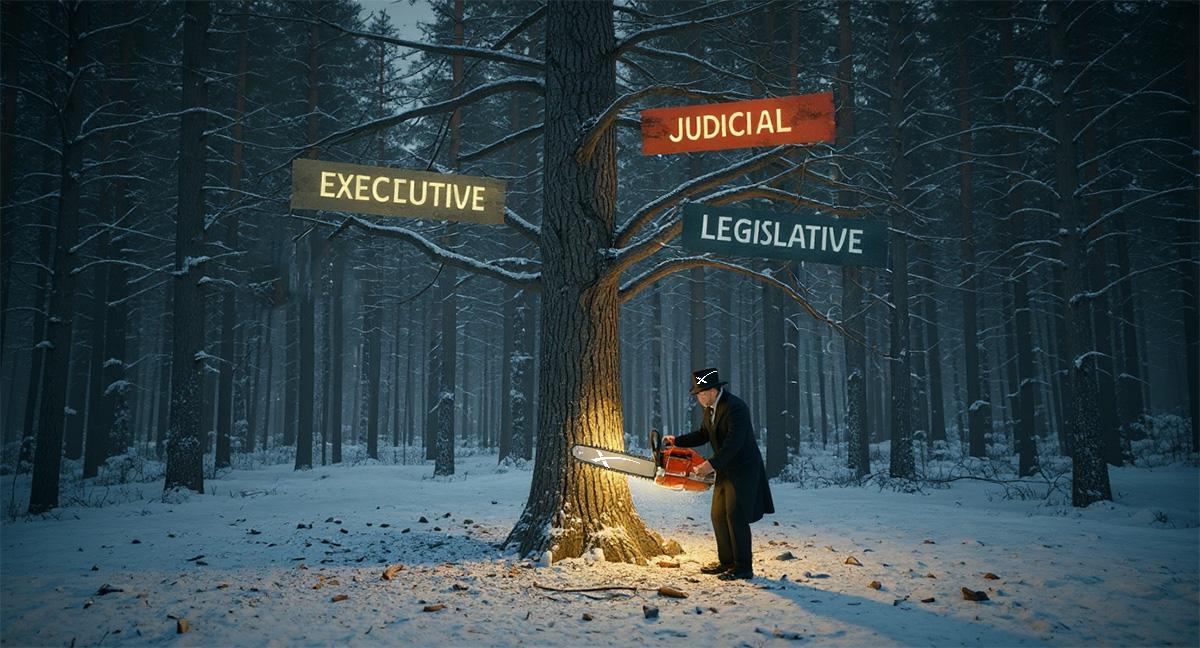
No one is alive who can recall those long years ago, when Tom, John, Ben and the rest of the boys were sitting around, smoking their clay pipes and discussing whether we should be a monarchy or a republic. Whether we should allow slavery or permit freedom of religion. It’s clear that they never chatted about having three equal branches of government …legislative, executive, and judicial.
Oh, we know they talked about dealing with the British, overriding Presidential vetoes, enacting tax laws…even declaring war, but making decisions when there was an impasse…not so much.
That first impasse arose a decade later when paunchy John Adams’ Presidency was giving way to that of tall, red tussled-haired, Jefferson. Both groups got into a snit, and a case every 1st year law student knows, Marbury vs. Madison, arrived at the Supreme Court. John Marshall, Chief Justice, and his brother decided that their court was the final arbiter of what the Constitution meant. Their decisions would henceforth stand on par with the other two branches of government. Our embryonic country had created something novel…three co-equal entities…a check and balance system!
In 1863 it was the Court who decided that a State could not succeed from the Union. Time, and again, it would be the courts who decided when the Legislative or Executive branch had overstepped their authority. In the 1930’s it was the Supreme Court who deemed that several major programs of FDR’s New Deal were unconstitutional.
Article 1, Section 8 of the Constitution gives Congress the authority to declare war. as they did in December 1941. Since then, our country has been involved in repeated military actions around the globe…Korea, Vietnam, Afghanistan, Desert Storm, and more. Not a single one was authorized by Congress!
Presidential Executive Orders are intended to deal with urgent, unanticipated situations, yet they have evolved as a way for the Executive Branch to avoid Congressional approval.
Our 1st nine Presidents, spanning a half-century in aggregate, signed only 40 Executive Orders. In the 20th century, Executive testosterone exploded as Teddy, Woodrow, Calvin, and Herbert, each signed more than 1,000 such orders. FDR, in office for 14 years, signed 3,700, as he tried to ameliorate the depression and fight a war. Since then, Presidents have returned to issuing hundreds instead of thousands. In the 1st month of his current term, Donald Trump has issued 65 Executive Orders and there doesn’t seem to be a letup in sight. When they align with our political beliefs, we are for them…Congress takes too long. When they don’t align, we shout Presidential Overreach.
But the issue isn’t just the battle between Congress and the President. Ultimately it is whether the Court continues to recognize its pivotal role and whether the parties will abide by the Courts’ decisions.
In Germany, 1932, a country disintegrating midst hyperinflation, Adolph Hitler took power. People wanted food and jobs and a leader who could lead them out of their economic morass. Hitler acted, ignoring the courts and the judiciary. We all know what followed.
The United States is a democratic republic. We elect representatives who are supposed to serve our interests, and it is our hope that their collective wisdom will stabilize our lives and maintain the peace. Extremes on both the left and the right have always been moderated by our form of government, allowing for a smooth transition of power.
In 2000, it was the Supreme Court who decided who won a close election. The loser, Al Gore, respectfully withdrew. In 2020 violence in our Capitol and rampant claims of fraud frightened the electorate but our system survived.
And, although we have three equal branches of government, we have no roadmap if one of them decides to simply ignore rulings. It has happened in other countries. It is called a coup d’etat. We are rightly proud that it has never happened here. Whether the current disintegration of our political discourse means an end to rational cooperation is something that remains a legitimate concern.