Most of us have a very limited knowledge of North American history. This ‘New World’ was discovered by Columbus in 1492, and he found some strange looking people, half-clothed, living here in what he believed was the most uncivilized manner. He named them Indians because he thought he’d reached India. It turns out that he was a terrible navigator and not very bright.
At the time he arrived here there were already from 5-10 million indigenous people living across the country in more than 1,000 recognized tribes and they’d been here for quite some time, living in organized societies and relative comfort.
Anthropologists are pretty certain that man first walked erect in Southern Africa 5-7 million years ago. It took another few million years for them to learn how to make stone tools. A generation is 20 years, so that’s 250,000 generations…a whole lot of mother/daughter, father/son confrontations. Imagine a stone-age mother telling her daughter not to put a bone in her nose and the daughter responding ‘Mom, all the kids are doing it these days.’ Those kids began to leave home and moved north into Europe and the Middle East…eventually reaching Asia a little more than one million years ago.
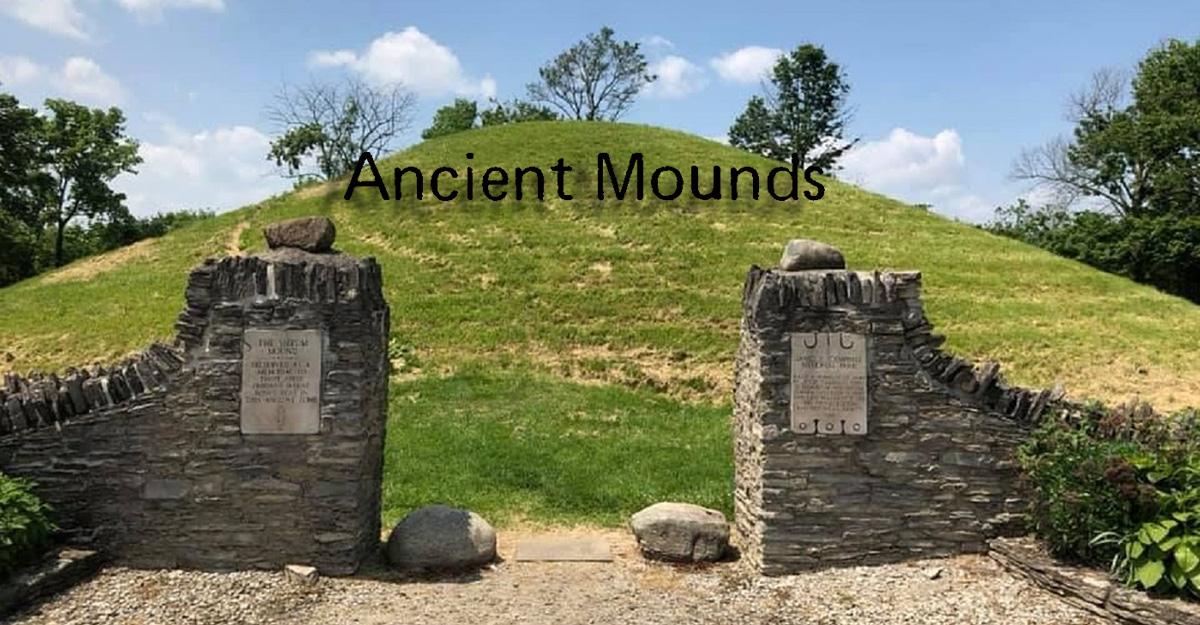
About 100,000 years ago their kids traveled across the Bering Straits and continued south into what is now Canada and the United States. They were mostly hunters, following the animal herds until about 10,000 years ago when maize mutated and became a food staple, allowing some to become farmers. People continued to drift into Central and South America, while more spread to the East Coast. Native populations prospered, became more diverse as languages and customs evolved. The history of a culture’s origins has generally passed from one generation to another orally. But not always! Across parts of Ohio huge mounds were discovered in the late 18th century when American settlers first arrived to build settlements. These mounds, known as Hopewell, were built around 100 B.C., before Christ, before the Incas, before Stonehenge, during the peak years of the glory of the Roman Empire.
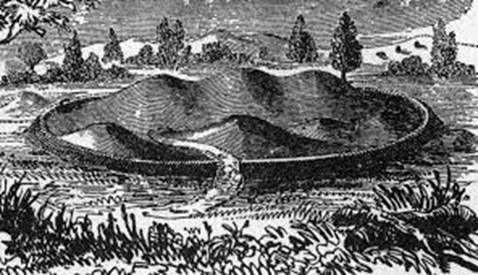
Diaries of early American settlers indicate they asked the local Indians if they knew anything about the people who built them…they did not.
Yet, whoever lived them possessed unusual skills. They were able to build precise walls, two miles long and a mile wide. They were also skilled artisans, trading their goods with other tribes from present-day Kentucky to Florida using rivers as highways to travel long distances.
These mounds were both ceremonial and funereal. Exotic objects and art have been found within excavated areas, including a mica bird claw, a copper bear paw, and a mica hand with its elongated fingers stretching upward. The artifacts were often made of exotic materials not found in Ohio. Huge ceremonial blades made of obsidian from Yellowstone National Park, some 2,000 miles away, were discovered, validating a vast, thriving trade network.
We are in awe of great ancient works that have survived the centuries…rightfully so. We should also be in awe of ancient mysteries still unsolved, such as the plains of Nazca, the building of the Pyramids, and the origin of the Hopewell mounds.