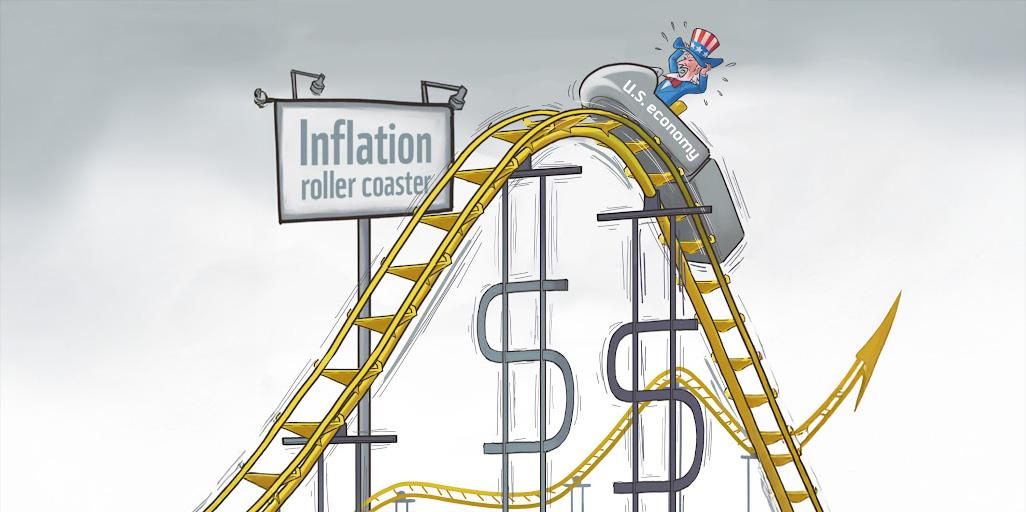
Our economy is at it again…inflation, recession, stagnation…too much of this, too little of that…an uncertain financial future. It’s called a ‘business cycle’ and we’ve had nearly a dozen spread across our country’s history.
The biggest and longest one was, of course, the Great Depression of the 1930’s. Following an ebullient decade after World War I, in October 1929, an overheated stock market and wacky bank lending imploded. Food lines, massive unemployment and national fear followed. It didn’t ease until the country ramped up production and hiring for the 2nd World War in 1940.
One of America’s first financial panics occurred in 1837. The early 1830’s had been prosperous years. Speculation had pushed up the price of land in America’s west. Cotton was in demand around the world. Even the price of slaves had gone through the roof. Europe was prosperous and a lot of American products were being shipped overseas.
Then demand from overseas slackened. Western land prices dropped, Wheat crops were lost to frost and infestations. Oversupply drove cotton prices down and without a central bank to control policy, there was a run and banks closed their doors. The economy stopped as if an unseen foot had slammed on the brakes. The recession would last two years +/-.
Wars have always created a pent-up demand. The automobiles and refrigerators unavailable in the early ‘40’s were gobbled up once the war was over. The same had taken place after the Civil War as demand rebounded. Land, housing, and too many new railroads built on borrowed money. In 1873, major fires in Chicago and Boston, as well as the Franco-Prussian war in Europe, created staggering losses. Our economy collapsed and remained stagnant for nearly a decade.
Since the economic trough in 2008 we’ve watched stock market prices rise sharply. There was global optimism, but then…BOOM! First the COVID pandemic, then a disruptive election and a divisive society. Finally, the Russia’s invasion of Ukraine. Optimism shrank as prices on items we used began rising every day.
The Chicago Board of Trade is an exchange that focuses on commodities…wheat, corn, pork bellies. Similar exchanges set prices for metals and oil. They all deal in ‘futures’ contracts. What will a bushel of wheat to be delivered in December cost? A barrel of oil? Do we think it will cost more or less? There is a global trading system on almost everything and when Ukrainian wheat is prevented from reaching European customers, the price of wheat will increase everywhere.
When Russian petroleum is withdrawn from the world market because of sanctions, the world price for oil rises. In 2008 oil reached $160/barrel. In 2016 and, again, in 2020 it fell below $40/barrel. Today it sits over $120/barrel. It moves immutably to the laws of supply and demand.
Meanwhile, an increasing number of major hurricanes in the Gulf has reduced refining capacity. The result is the current surge in gas prices at the pump. Our world moves on fossil fuels, so transportation costs have jumped and the costs of moving everything from grapes to plywood to steel are affected.
It will end at some point, and the world will return to a new type of normal. Meanwhile, all one can do is deal with it. Perhaps a glass of wine will help. The cost of a pleasant wine is still tolerable and rests nicely on the palette!