
It’s time for a historic non-event. What better than the dire warnings and near-panic as we approached the end of the 20th century. An unforeseen enemy…the Y2K bug…the Millennium Bug, would end life as we knew it. OMG, what will we do?
Prior to the widespread use of computers in the 1960’s, the world used punch cards and tabulating equipment to keep track of everything from airplane schedules to personnel records and military everything.
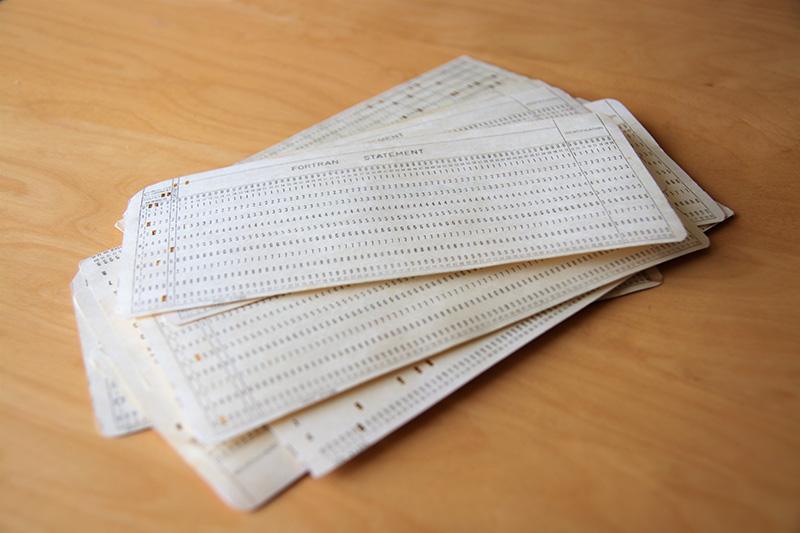
Each punch card had 80 columns…80 pieces of information, i.e., an employee or customer number, perhaps a pay rate of discount code. It was important to put as much information in those 80 columns as possible so why use 4 digits for year…let’s just use the last 2. For example, January 1, 1960, was stored as 010160, using 6 bits instead of 8.
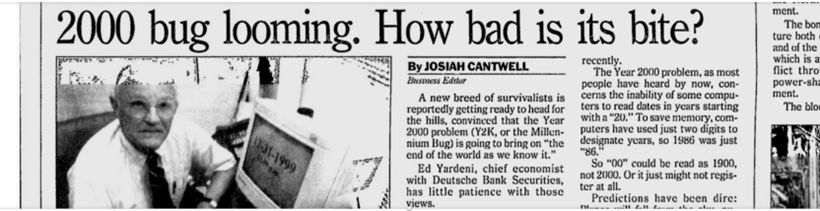
No one thought about it as we moved into the era of stored data, after all, we’d always done it that way. But, as we approached the late 1990’s, it suddenly dawned on the world that a computer might recognize January 1, 2000, as January 1, 1900.
Computers use dates for many things, everything from turning your home’s sprinklers or lights on and off, to controlling power plants and refineries. Banks and credit card companies used dates to calculate interest. The entire world’s financial system could go awry.
Each punch card had 80 columns…80 pieces of information, i.e., an employee or customer number, perhaps a pay rate of discount code. It was important to put as much information in those 80 columns as possible so why use 4 digits for year…let’s just use the last 2. For example, January 1, 1960, was stored as 010160, using 6 bits instead of 8.
No one thought about it as we moved into the era of stored data, after all, we’d always done it that way. But, as we approached the late 1990’s, it suddenly dawned on the world that a computer might recognize January 1, 2000, as January 1, 1900.
Computers use dates for many things, everything from turning your home’s sprinklers or lights on and off, to controlling power plants and refineries. Banks and credit card companies used dates to calculate interest. The entire world’s financial system could go awry.
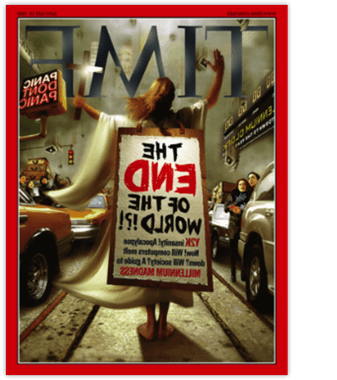
Early in 1999 Time magazine’s cover touted “The End of the World?” The very next day, Bill Clinton included in his state of the union address, “We need every State and local government, every business, large and small, to work with us to make sure that the Y2K computer bug will be remembered as the last headache of the 20th century, not the first crisis of the 21st.”
Mis-scheduled traffic lights would cause pile ups. Cash machines would stop working. The American Red Cross issued warnings that people should withdraw cash and keep it in a safe place, fill their gas tanks, have alternative cooking methods planned and extra warm clothes in abundance.
One New York Times article highlighted the threat to the medicine supplies, warning that people could die if the medicine supply were affected. From drug production and delivery to pharmacies and their electronic point of service systems, they were all potential glitches in the drug supply chain.
Prisoners would be released early. Criminals would somehow use the opportunity to get away with more crime. Conspiracy-crazies declared this would be the end of civilized order. Large lines began forming at cash machines all over the world.
On December 29th, 1999, there was a large credit card machine outage across England. This was proof…the first sign of Y2K disasters to come, the beginning of the end!
Knowledgeable people warned of overreaction. They were ignored. In the end there were no crises…no one died, airplanes didn’t fall from the sky, elevators didn’t plummet. Computer ‘fixes’ had been developed, and we have moved into a new century with little more than a few new grey hairs.
We apparently like to panic. In 1938, a radio program convinced listeners we were being invaded by Martians. A few years ago, we hoarded toilet paper. Which reminds me…I’m down to my last forty rolls.