In June 1971 the relationship between the American people and its government changed dramatically. Today, 52 years later, the scars of that event remain.
In 1933 when Franklin Roosevelt spoke to us in one of his Fireside chats, we crowded around the radio and listened as he reassured us that things would get better. The dark days of the Great Depression would pass. We believed him. He was our President, the leader of our country.
In 1941, after the unprovoked and surprise attack on Pearl Harbor, our country declared war against the Axis powers of Germany, Italy, and Japan. Our leaders told us that we’d all have to sacrifice, maybe even give our lives. Again, we listened, we understood, and we went into battle, and into factories, with unswerving trust.
When the war ended in 1945 and our husbands, sons, and daughters returned to our shores, we went back to our lives. Some finished college. Some raised families. We hung flags on the 4th of July, and we voted in the Fall. We were one nation, still proud…still unified…still patriotic.
But when we sent troops to some place in Asia called Korea in the 1950s, we began to have doubts. We hemmed and we hawed. Why Korea? Our way of life wasn’t under threat, but our government said it was necessary. They’d always been right, so we believed and, reluctantly, we sent our most vital asset, our young people, into battle.
Our country was changing. A new generation of leaders was emerging. We were now facing an Iron Curtain and a Domino Theory. Threats of nuclear war and ICBMs unsettled us.
One President sent a few military advisors to stabilize a small country in Southeast Asia. The next one sent a few more. It was all very secret. But then we were asked to send young men and weapons to support those advisors in some piss ant country on the other side of the world that we’d never heard of. A few of asked, “Why?’ But it continued. More troops…more people asking why.
Trust your government! Eisenhower, Kennedy, and Johnson had allowed our involvement to grow despite growing dissatisfaction. Richard Nixon’s Silent Majority, however, supported the government’s prosecution of the war. But the cacophony had grown louder and in June 1971 200 years of trusting our government ceased to be an enforceable contract. The Pentagon Papers were revealed.
A man named Daniel Ellsberg was the lynchpin. At the request of Secretary of Defense Robert McNamara, Ellsberg and three dozen other analysts were asked to prepare a history of our involvement in Vietnam. It was ultimately a 7,000-page analysis of events…all of it. And, while working on the project Ellsberg had become an ardent anti-war activist.
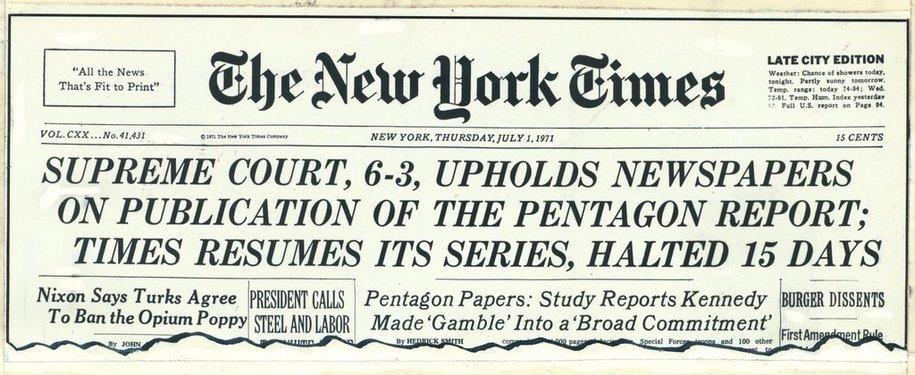
The Pentagon Papers revealed the secrets and misinformation our military and government had pursued to justify sending more men and materiel. There was no Gulf of Tonkin incident that became an excuse to increase bombing and draft more troops. There was no justification for military actions in neighboring Cambodia and Laos. It was simple, our Generals said. ‘We’ve almost there…just an additional $5 billion in planes and tanks and another 5,000 troops.’
By 1974, when the final helicopters left Saigon, nearly 70,000 Americans had given their lives, nearly one million Vietnamese had died, and we had spent $200 billion.
Our leaders had learned they could lie to the American people and spend money at will. These were lessons that have now evolved to a national debt of $33 trillion, leaders unable to govern amicably, and a population thin-skinned over issues of race, gender, geography, and income.