Israel & The Palastinians
There have been hundreds of books, thousands of articles, and millions of lives lost dealing with the monstrous conundrum we call the Middle East. Authors of impeccable credentials, historians, statesmen and journalists have published notable commentary. Men of religious indignation, professing rationale for each position, some literate, some simply cacophonous, have set forth arguments for accountability on both sides.
I am neither historian nor journalist. I am not politically motivated nor am I filled with the fervor of religiosity. I am simply a pragmatic Western-educated woman, who has watched from the sideline of the conflict. This apple fell from a secular Jewish tree, aware that my grandparents had lost family in the Holocaust. I’ve visited Germany, Israel, Turkey, the Soviet Union, Uzbekistan and other involved parts of the world. Yet, for me, the longest mile I’ve traveled is trying to fully understand the roads and byways that led us to this seemingly perpetual confrontation.
This paper is an attempt to illuminate in a brief way the events and players on both sides that have brought us to the present-day schism. It all did have a beginning…before most of us were born. How did we get here? My goal can best be summed up by a famous quotation: “If we do not understand history, we are doomed to repeat it.”
The Crisis
We are once again in the midst of a Middle East conflict. Were we ever not? It is conflict that seems to defy resolution! A conflict that is increasingly polarized! You are either for Israel, or you are not. If you are not, you are an anti-Semite. Words like Jihad, Axis of Evil, wars for oil, and terrorists color our rhetoric. Newspapers show pictures of the effects of suicide bombers, Katusha rockets and captives awaiting execution across Afghanistan, Pakistan, Israel, Lebanon and Iraq. We argue constantly over the advisability and direction of the current military campaign. We have evolved from a localized Israeli Palestinian conflict to a global war on terror. In the blink of an eye the battles in Gaza and the West Bank seem indistinguishable in our minds from earlier battles in Vietnam and Kabul.
But we have forgotten where many of these issues came from. The world had a different type of complexity in the mid-20th century. It was before computers, television, moon landings and I-Phones. Yet the decisions made then have set the scene for what the whirlwind reaps today. A greater level of knowledge is essential to understanding the anger and aspirations of both sides. The violence and hatred are silencing moderate voices.
In the Beginning – As Christianity flourished and exerted its influence throughout the first millennium those that remained Jewish became more and more isolated from the general population. Shakespeare’s Shylock in the Merchant of Venice became a caricature of the hooked-nose money hungry Jew. Jews were isolated into ghettos, vandalized and scorned as the killers of Jesus.
The second millennium saw the rise of cities, the Dark Ages, and wars for land. The Crusades, Napoleonic Wars, the Spanish Inquisition, and the rise of the Ottoman Empire continuously altered the maps of the world. Discovery of the Americas and wars for colonial power were taking place across the globe as European nations fought to exploit distant lands.
Jews continued to represent a tiny unassimilated segment of society. By the 19th century as poverty and hunger ebbed and flowed across Eastern Europe, it was easier to blame the Jews for the ills of society than the Tsars. Pograms, the killing and ravaging of Jewish ghettos, flourished! Small groups of Jews came to believe that their survival lay in the establishment of a separate Jewish national state. Zionism had been born.
ZIONISM – Zionism’s father and first voice was Theodore Herzl. World Zionism Congress’ were held in the last decades of the 19th century as the concepts coalesced into organization. Then the entire area we now know as Palestine had only 700,000 inhabitants of which only 55,000 were Jews. Of those a mere 550 might describe themselves as Zionist pioneers. They settled into Jerusalem, Hebron, Safed and Tiberias, establishing agricultural communities working alongside Arab farmers in a spirit of self-help and hard work.
Pressure for a Jewish state in those early years was not limited to the Middle East. One locale considered by the British Parliament was Uganda, at that time a British protectorate called British East Africa. While this sounds implausible today, it should be remembered that Britain had a long history moving groups or cultures from its shores. The American colonies had been populated with overflows from debtor prisons. Quakers, Puritans and other sects preferred to leave rather than confront the pressures of the Anglican Church. After the Revolutionary War, Britain continued to populate the Caribbean, Africa and Australia with English ‘undesirables.’
WORLD WAR I – In 1914 Germany was marching across Europe. Britain remained the only power capable of stopping the onslaught but it needed help. America wanted no part of a European war. Influential government officials within Whitehall, Britain’s government center, came to believe that supporting the eventual establishment of a Jewish national state in Transjordan, a British protectorate, might encourage the large Jewish population in Russia, almost entirely Bolshevik supporting, to open an immediate front against Germany and force the Kaiser to divide his forces.
This British policy was called The Balfour Declaration and became the first modern day official policy supporting establishment of a Jewish national state in the Middle East.
Russia joined in the fight against Germany and in 1917 after German boats sank the Lusitania, the United States entered the war. The AEF, American Expeditionary Forces, landed in Europe and broke the stalemate that had developed.
When the war ended in 1918 each country returned to tending its own wounds. The League of Nations was established but America’s isolationism won out and the United States never joined. Meanwhile European countries demanded huge reparations from the enemy they had defeated and in so doing, planted the seeds that would eventually lead to World War II.
The Balfour Declaration was forgotten by all but rabid Zionists. German Jews felt Germany was still their home, as did those in France, England, Russia and the United States. The 1920’s was a decade of prosperity. Why leave a prosperous life to join an agrarian commune in a faraway place? When the prosperity of the ‘20’s gave way to the depression and despair of the ‘30’s, however, that trickle increased as more Jews gambled on a better life.
NAZI GERMANY – Burdened not only by the effects of the depression but also by the reparations it was forced to pay, the country’s Weimar republic ceded power to the Nazis led by Adolph Hitler. It was the Jews, gypsies, homosexuals, intelligentsia and their ilk that had defeated Germany, he cried. The country needed to cleanse itself of such decadences and return itself to the purity of the Aryan race. Germany began to rearm. Some Jews left but most remained, convinced the Nazi madness would give way to eventual sanity. But by 1939, as the German blitzkrieg moved across Poland, the Low Countries and into France, it was too late. Borders were closed and the Nazi fixation against the Jews spread like a plague across Europe.
It would take nearly five years before the clouds would lift, and the world would see the madness that had been wrought. Twenty million combatants and civilians had been slaughtered.
The Holocaust – Revealed to an unsuspecting world were the concentration camps and gas chambers that had slaughtered six million Jews…men, women and children, young and old, herded into box cars like cattle and taken to concentration camps for extermination. Names like Auschwitz, Dachau, and Bergen-Belsen brought tears as army films revealed stacked skeletal bodies and near-death survivors. The world was appalled. Six million had perished but another nearly half million survived, ill and undernourished, all homeless, families ripped apart, and possessions long gone. It was implausible to send them back to the countries whose antisemitism had permitted, and often encouraged, these atrocities.
Meanwhile the Allied nations faced other issues. Russia, now the Soviet Union under Josef Stalin, had, as Churchill noted, brought down an ‘Iron Curtain’ across Eastern Europe. It was the onset of the Cold War, a nuclear arms race and a need to rebuild Europe after years of war. The ‘Jewish problem’ was not the world’s most pressing issue.
Great Britain – Great Britain advised the United Nations in early 1947 that it could no longer continue to oversee Transjordan. It, too, had suffered during World War II and needed to focus on its domestic reconstruction. The wartime leadership of Winston Churchill had given way to worries of unions, Irish violence and the economy. In 1945 India gained its independence from Britain and the British Commonwealth continued to shrink as the century of Colonialism was ending.
The original British protectorate established after World War I and the fall of the Ottoman Empire, contained two responsibilities, Transjordan, that area west of the Jordan river, equal to 21% of the area, and the Emirate of Transjordan, today’s Jordan, the remaining 79%. In 1946 the latter portion was made independent and legally became the Hashemite Kingdom of Jordan under King Abdullah.
Britain had inherited a responsibility far beyond its ability to deal with the growing explosiveness of the situation. As far back as 1909 there had been violent outbreaks between the few Jewish settlers and their Arab neighbors.
David Ben-Gurion avowed, “We did not come here to expel the Arabs, but to build.” But the Arabs were desert nomads, not builders of cities. Their culture did not drive them to achieve and better themselves. The Koran had told them that this world was not where they would find a better place. But it was their land, and their families had lived there for centuries. It was not someone else’s to give away.
During World War II both sides worked to build political influence with England. The Jews served militarily with the British forces. The Arabs, many pro-German because of the Jewish issue, were appeased, as access to the vast Middle East oil reserves of the area became critical to winning the war.
Partition – In 1947 the United Nations set up a special committee to investigate and report to the General Assembly on the situation in the Middle East, the future of Palestine and its relationship to the hordes of homeless Jewish refugees. UNSCOP, United Nations Special Committee on Palestine, began its work.
The committee consisted of representatives from eleven nations. These included only those that had a humanitarian and not an economic concern, such as Canada, Iran, Netherlands, Peru, Yugoslavia and Czechoslovakia. They toured Palestine on several occasions and took testimony from Arab and Zionist leaders. They spent time in Lebanon, Syria and Transjordan and an entire week visiting DP, Displaced Person, camps in Germany and Austria. More than 200 reporters were accredited to the committee. The Arab High Committee, representing the interests of Arab nations in the area, demanded that Palestine be given its immediate independence. Jewish groups worldwide lobbied for a Jewish state. There was a lot at stake!
In August 1947 the Committee formally rejected extreme solutions offered by both the Arabs and the Zionists. The Arab right to the territory was recognized by virtue of their being the indigenous people and preponderant population residing there. The Jewish right was acknowledged by virtue of their historical association with the country and international pledges made to them. The real problem was more basic.
There were 1.2 million Arabs and 600,000 Jews with intense nationalist aspirations in an area both small and poor in natural resources. Everyone agreed that Palestine should be granted its independence but beyond the concept there was no consensus on how it should proceed. It was indefensible to accept the full claim of one party at the expense of the other. The only reasonable solution, it was believed, was a bi-national state sharing some form of political party. (Fig 1 UN partition map, 1947)
A consensus was reached on several matters. First, there needed to be a transitional period from the cessation of the British mandate until independence was official. Second, the sacred character of the Holy places of Christians, Jews and Moslems should be protected and rights of access assured. Religious communities within Palestine should not be impaired. Their rights should continue unabated. Arbitration to settle religious disputes impartially would need to be established. The 500,000 remaining Jewish displaced persons of World War II were a related issue and their integration into Palestine could help address the population inequities. Human rights and full protection of minorities were to be paramount considerations.
Eventually, and despite all these pressures and the increased anger and vitriol of the parties, it was decided, by less than a unanimous vote of the committee, to support partition. Two separate entities would be established with the hope that this would minimize the possibility of violence. Both nations require extensive international financial assistance to develop agriculture and irrigation systems.
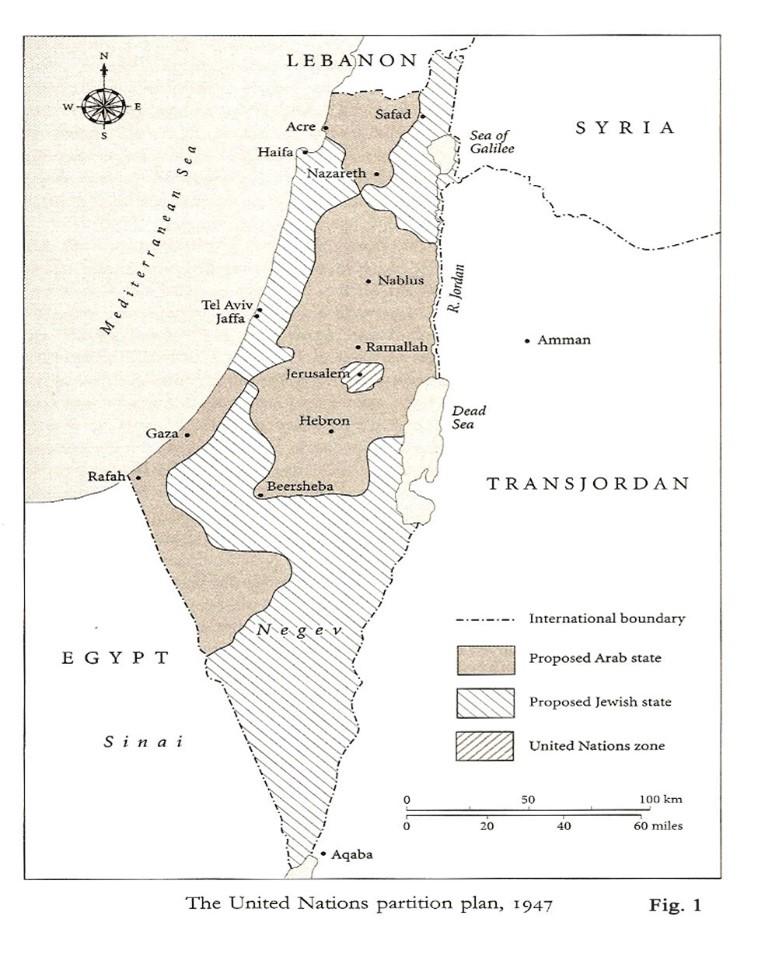
Three entities would be established: An Arab state called Palestine, a Jewish state, and the City of Jerusalem, to be set up as an International Trusteeship. Palestine would include Western Galilee, the hill country of Samaria and Judea and the coastal plain from Isdud to the Egyptian frontier. The Jewish state would include the Eastern Galilee, the Esdraelon plain, most of the coastal plain and the districts known as Beersheba and the Negev.
The divisions made sense. The inland area to be Palestine contained practically no Jews. The remaining Jewish settlements represented a tiny minority. The Jewish state, on the other hand, would have Arab population centers throughout its borders. The Arab state would have a total population of 735,000 of which only 10,000 Jews resided. The Jewish state would have a population of 900,000 including 500,000 Jews and 400,000 Arabs and other minorities. The City of Jerusalem would have a population of 200,000, equally divided between the two cultures. In addition, during the transition period, displaced Jews would be allowed to immigrate to a limit of 30,000 per month to a maximum of 150,000.
It was hoped that by creating a Jewish state with similar population clusters of Arabs and Jews that a peaceful bilateral government could be established.
The committee wrote of its concerns that a wider Middle East war could be fueled by religious rancor. If a small state, financially supported by the international community, were able to develop tolerance between these two disparate factions it might bring amity to the region. As we look back from a vantage point of more than seventy years, we know the objective failed. They had hoped for something better but within two years the evidence of their failure would be known throughout the world.
The State of Israel was formally established by United Nations Resolution 181 but immediately condemned by all the Arab states. President Harry Truman, against the advice of the US State Department, immediately recognized the State of Israel. Russia followed, and a new state of affairs existed in the Middle East.
INDEPENDENCE – On 15 May 1948, the fledgling state was invaded by the armies of Egypt, Syria, Lebanon and Transjordan. Simultaneously, war exploded between the local Arab and Jewish populations. The Jewish army was hugely outnumbered but well organized. Effective military groups had existed within Israel for more than a decade. Irgun, Haganah and Palmach, had employed techniques of aggressive defense for a decade. The Palestinian Arabs had lost their leadership to the British during their periodic uprisings. Neighboring Arab armies fought without zeal for a cause in which they had no investment while the Jews, now Israelis, were fighting for their very survival.
The war ended before it began with each of the Arab armies in full retreat. Battles and UN-brokered truces continued to erupt until January 1949. During this period Israel worked to consolidate its territory into more defensible borders beyond the partitioned state concept of the UN. Arab populations were moved peaceably from Haifa, Jaffa and Tiberias. Arab villages within Jewish communities that did not want to assimilate were relocated.
The end of the war did not bring peace. The first glimmer of Pan-Arab unity began to evolve. Nations that had hated one another for centuries put aside their differences to decry Western colonialism…they had never cared before but now Palestine became a battle cry.
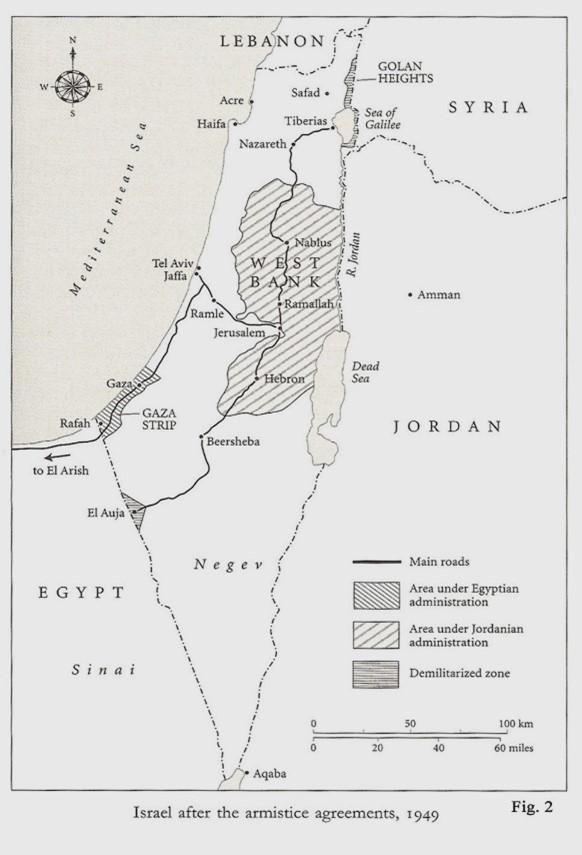
There had been the possibility of an early truce with Jordan. Jordan had had its own skirmishes with the Palestinian Arabs. As it happened, the peace overtures of King Abdullah were rejected by his more conservative political groups and the idea died. Jordan was caught in the middle. It did not have oil riches or seaports, and it feared its Arab neighbors as much as it feared Israel. Jordan was as artificial a national state as Israel. It had been created by Western powers. The 1948 war had now killed partition and the establishment of separate Jewish and Arab entities. Jordan annexed the West Bank, the largest portion of what was to be the independent state of Palestine. (Fig 2 Israel after Armistice, 1949)
In April 1949 the Lausanne Peace Conference was convened by Arab states acting in unison. Their proposal was filled with extremes never accepted by either side. Instead, in July 1949 Israel and Syria signed an armistice. It could have meant a permanent peace between the countries but in late August the Syrian government was overthrown. Those who had pushed for peace were killed and, once again, Israel found itself with an intractable neighbor to its north.
The Sinai Campaign – 1956 – None of the combatants believed the battles of 1948 would be the last. The rhetoric had grown more inflammatory. All parties were rearming. Israel wanted a preemptive strike against Egypt. King Farouk was gone but, in his stead, Gamal Abdel Nasser, a general with a huge ego had assumed dictatorial control of the country. The U.S. was adamant against Israel striking first and used the threat of withholding arms and planes that Israel would need. Israel needed another ally and found one, unexpectedly, in France.
France was struggling with its own colonial war in Algeria. They found it had been made more difficult by the support Nasser was providing the Algerian insurgents. France agreed to sell arms to Israel, including the versatile Mirage jet fighter. The United States had refused to help Nasser build the Aswan dam and Egypt turned to Russia for financial and construction assistance. Then in 1956 Nasser nationalized the Suez Canal, an action that could not be tolerated by European countries who depended on the Canal as a primary trade route. Three months later, acting in unison, Israel attacked across the Sinai Peninsula while British and French forces attacked along the Suez Canal. In one week, the entire peninsula was under their combined control. Unfortunately the combined pressure of Russia and the United States forced all foreign forces to leave. All that was achieved from these incursions was the demilitarization of the Sinai and, for now, a peaceful coexistence with Egypt.
Politics and vitriol continued. In 1958 Nasser formed the United Arab Republic, UAR, a union of Egypt and Syria and with it he gained stature. In 1964 at an all-Arab conference, under his guidance, the PLO, Palestine Liberation Organization, was established. It became Arab doctrine that the issue of Palestine would supersede all other Arab differences of opinion.
The 1950’s also saw Israel’s successes in international diplomacy. It established relationships with Turkey, Iran and Ethiopia, who shared worries about Egypt’s aggressions. Israel also worked to build relations with many countries in Africa and shed its image as a ‘western colonial’ outpost.
In Israel paranoia continued to flourish. “Never Again” became the nation’s mantra. There was continuing fear the United States would, under some President, withdraw its support. This fear drove Israel to accelerate development of a nuclear option. At Dimona, deep in the desert, defensive nuclear weapons were developed. Their plan succeeded. Under President Kennedy, the U.S. agreed to help maintain a balance of conventional military parity in the Middle East and thereby negate Israel’s need ever to use nuclear weapons.
The Six Day War – In 1966 a revolt in Syria brought new cries for war. In Egypt, with Russian support, missiles, and MIG’s, Nasser roared with a renewed confidence. Cooperation between Jordan and Israel to develop the waters along the Jordan River to their mutual benefit was scuttled by Jordan’s Arab neighbors. The United States was increasingly bogged down in Vietnam, allowing Russia to increase its influence. On June 5, 1967, war finally erupted. The parties had postured themselves into corners that would not accept lesser positions.
Israel faced Arab armies on each of its flanks. Nasser, now well-armed, faced Israel across the Sinai. Syria, and its Ba’ath militants in Damascus, stared across the Golan Heights. Jordan and Iraq, having also been signatories to a mutual defense pact, sent an Army across the Jordan River. The Israeli victory was stunning in its speed and success. They effectively dismantled every one of their enemies. Arab countries had been humiliated. Egypt lost complete control of the Sinai. Nasser would never regain his stature. Syria lost the strategic Golan Heights and with it the source of the waters of the River Jordan. Jordan lost control of the West Bank and all of Jerusalem. 300,000 refugees fled the West Bank and settled in Jordan, swelling its refugee population to over one million.
These displaced families brought with them militancy and anger…they were ‘fedayeen’, Palestine resistance fighters, who fought openly with the Jordanian army and police until they were expelled in 1970 relocating a trained cadre of armed insurgents back into Israel.
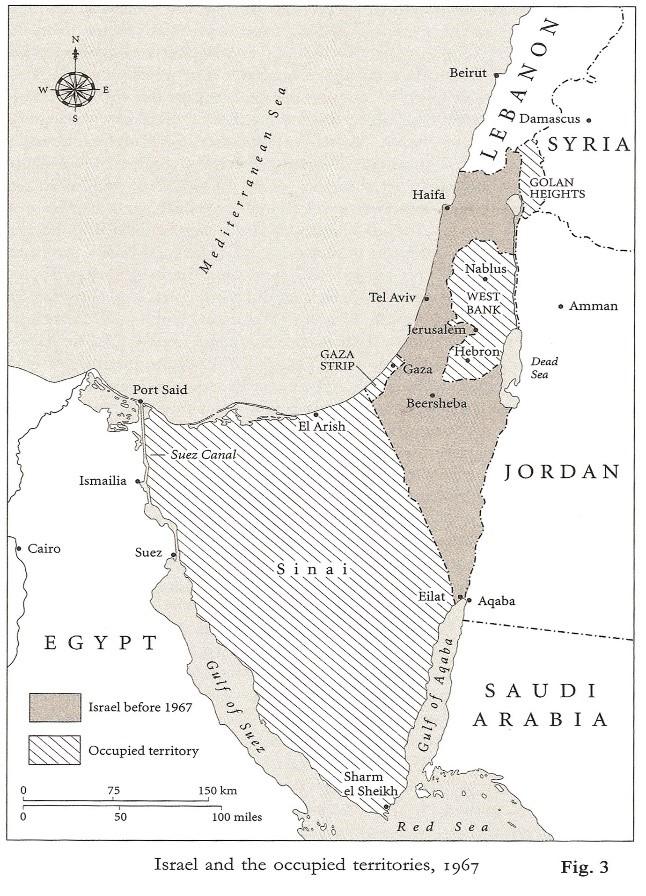
1966 – 1973 – The Arabs had launched the war to regain their national pride and destroy this foreign parasite that had been established in their midst. Israel, more confident and militarily assured than in 1948, now demanded respect and security. When the war ended Israel’s victories made the fledgling country 3½ times the size of the original 1947 partition. Could peace be assured if Israel gave back the land it won in military victories? Could Israel trade ‘land for peace’?
Land was a bargaining chip. And as near as it might come, it was not to be. Israeli hubris and Arab humiliation occupied those years from 1966-1973. Israel would not bargain over Jerusalem. Syria would not promise peace in exchange for regaining the Golan Heights. Egypt was not yet ready to sue for peace in exchange for return of the Sinai. Distrust and mutual distrust would not be assuaged. The UN approved resolution 242, encouraging negotiations of ‘land for peace,’ but the parties were intractable and the issues remained unresolved. (Fig 3 Occupied territories, 1967)The Yom Kippur (October) War – 1973 – Now it was Golda Meir, Israeli Prime Minister, Richard Nixon and Henry Kissinger dancing on the world stage. The latter were more interested in Soviet influence in the area than Arab-Israeli issues. In 1970 there was reputed to be 40,000 Soviet military advisors in Egypt. Soviet SAM missiles lined the Suez Canal. But that year Nasser died and Anwar Sadat came to power. He came to believe that the Russians and Americans had conspired to prevent Egypt from going to war, he expelled the entire contingent of advisors.
During this lull, if the Arab nations couldn’t attack Israel, the Palestinian PLO could. In 1968 they hijacked an El Al jet. Car bombs were exploded in Jerusalem. The central bus station in Tel Aviv was attacked. Israeli athletes in Munich for the Olympics were assassinated. Terrorism had been born!
Yom Kippur is the holiest day in the Jewish calendar and the country and its military were unprepared for the combined Egyptian and Syrian attack. Israeli forces lost several major battles the first week. Eventually the tide turned. In Egypt, Israeli forces crossed the canal, encircled the Egyptians and ended up within sixty miles of Cairo. The loss of more than ten thousand Israeli forces killed and wounded demonstrated to the world that Israel was not indestructible. It is rumored that Nixon and Kissinger refused to release desperately needed military hardware until Meir threatened to loose the products of Dimona to save itself. Israel had survived another war but at a high cost.
There would be no further wars with Arab nations. In 1974, based on a striking initiative from Anwar Sadat, Israel and Egypt would sign a military disengagement agreement. Later Sadat and Begin would each be awarded the Nobel peace prize.
In 1979 the Shah of Iran, long supported by the United States, was overthrown by Islamic students led by Muslim clerics. Iran became a fundamentalist state and, once again, the balance of power in the Middle East shifted. Moderates in the country were silenced and that nation’s hatred of both the United States and Israel became inextricably linked.
In 1982 Israel, struggling with incursions across the Lebanese border from Hezbollah guerillas, sent in a small invasion force. They hoped to form a union with Lebanese Christians and other minorities. They soon learned that Lebanon was weak and any long term solution to peace in that country would require peace with Syria. Israel would stay embroiled in Lebanon for 18 years.
The Oslo Accords – In 1991 following the Gulf War, the parties seemed open to furthering the peace process. Jordan, Syria, Lebanon and Pakistan, all Moslem nations, agreed for the first time to direct peace negotiations with Israel. At the Madrid Conference, sponsored by both the U.S. and Russia, conferences were held away from lights and political maneuvering. One major result was that in 1994 Jordan signed a peace treaty with Israel. Since then the two countries have worked to develop and save the River Jordan and have initiated a number of diverse cross-border business relationships. But the complex issues of Palestine couldn’t be resolved at Madrid. Instead, without fanfare, direct discussions were held in Oslo. Arafat, Rabin and Peres as well as others worked diligently to resolve their differences.
In September 1993 the Declaration of Principles on Interim Self-Government was signed with rigid timetables for dealing with unresolved issues. This Agreement returned Gaza and Jericho to PLO. Israel would stop building settlements in the West Bank. Arafat would be able to hoist his own flag, have his own Police Department. The new government would be responsible for all its own health, education, welfare and taxation. It would be a major step toward a new Palestinian State. It would also mark a new short-lived “high” in relations between Israel and its other Arab neighbors.
In both camps the agreement was received by some with derision. Arafat’s advisors objected to his ‘solo’ diplomacy. Rabin was attacked for appeasing the hated PLO. In November 1995 Rabin was assassinated by an ultra-right Jewish fanatic. His party lost the election and the hawkish Netanyahu came to power. It revealed a growing schism within Israel of religious right extremists, mostly residing in Jerusalem, and more pragmatic Israelis that resided in Tel Aviv. Another opportunity for peaceful progress would be scuttled. Israel no longer spoke with a single voice.
The Intifada – The last decade of the 20th century was filled with peace overtures, counter overtures and universal hope. Yitzhak Rabin, Shimon Peres, Arafat, the Oslo accords, Camp David, Shamir, Sharon, Mubarak, and Hussein all shared the fame and condemnation of the world stage. In 1985 Jordan’s King Hussein reached an understanding that Palestinian self-determination would take place through a Jordanian-Palestinian federation. There were also conditions that included recognition of Israel’s right to exist and renunciation of terrorism. The PLO was unwilling to accept these conditions.
By 1998 the Intifada was in full aggressive mode. It had become not only a revolt against Israeli occupation but its leaders also opposed any attempt by Arafat or Arab nations to resolve the future of Palestine by any peaceful means. The Intifada had become more influential than the PLO. In 1998 the Palestinian National Council accepted the State of Israel and endorsed all relevant UN resolutions but this interlude would be overshadowed by aggression and violence on both sides. Even the Oslo accords of 1993 acknowledging a mutual recognition failed to ease the conflict for long.
During these years Israel grew by more than 7% per year as it increased its world trade and influence. Palestinian income more than doubled. One-third of all Palestinians worked in Israel. Still the number of Palestinians below the poverty line increased and only those who lived near Israel’s cities benefited. Whether by plan or by accident neither Israel nor the neighboring Arab countries made any effort to reduce the poverty in the remainder of the country.
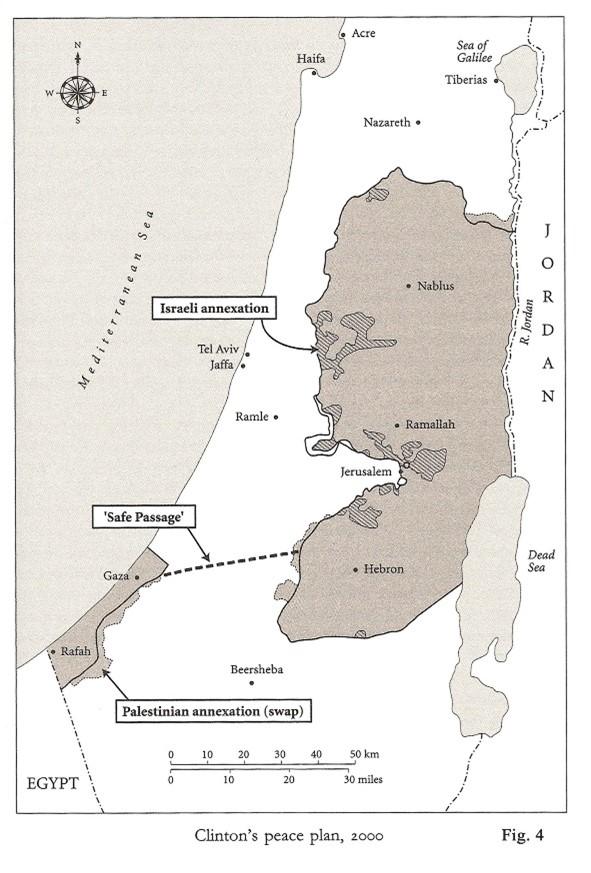
In September 2000 Ariel Sharon, successor to Netanyahu, and every bit as hawkish, staged a visit to al-Haram al-Sharif, the Moslem Nobel Sanctuary and holy site in Jerusalem. He was flanked by a thousand security men and proceeded with complete disregard for the sensitivity of Moslem worshippers. The 2d Intifada, led by the Al-Aqsa brigade, erupted. Suicide bomber volunteers were plentiful and with each indiscriminate killing, the schisms deepened. More recently the death of Arafat and the increased acceptance of Hamas as the voice of the Palestinian masses seem to have made peace a more distant reality. (Fig 4 Clinton peace plan, 2000)
The Israel Lobby – The United States has supported the State of Israel while simultaneously working to be an even-handed partner to resolution of the disputes. The U.S. gives, and has given, significant foreign aid to Israel. It is committed to protecting the interests of this small country. Much of this support stems from an aggressive and effective lobby within the U.S. defending Israel’s actions, often without moral justification. Even when the interest of the two countries has not always coincided, this lobby has found ways to minimize overt criticisms.
The U.S. has been unsuccessful getting Israel to limit building settlements in the West Bank and areas to be eventually returned to the Palestinians. The relationship also provided Israel with a much leveraged position in her responses to Palestinian violence. Early on Golda Meir said, “We can forgive the Arabs for killing our children but we cannot forgive them for forcing us to kill their children. We will only have peace with the Arabs when they love their children more than they hate us.” This indiscriminate killing of civilians by suicide bombers and Hamas, led to heavy Israeli reprisals. Limited or measured response had been discarded as an ineffective military option.
IRAQ – Desert Storm turned the world’s attention to the periphery of the Palestinian-Israeli problems. Iraqi missiles flew into Israel and the U.S. installed Patriot anti-missile sites to keep the Israelis out of the main conflict. But the 9/11 attack on the World Trade Center and the American invasion of Iraq to topple Saddam Hussein created an unforeseen confluence of events.
The initial Arab-Israeli problem focused on the plight and future of the Palestinians and the threats to Israel’s survival by the action of its neighbors. Later the Arab League was formed to provide a single voice for Palestinian rights among the concerned countries.
The destruction of the World Trade towers in New York and the war in Afghanistan showed a new face to the West. Al Qaeda and the Taliban had little concern with Palestine. Their anger and violence arose from what they viewed as an overriding arrogance by Western democracies. Their interpretation of the Koran spoke to them….destroy all infidels!
Meanwhile the old fears of Christians occupying Moslem lands have ignited the less educated masses of all the neighboring countries. Israel, once again, is seen as a Judeo-Christian outpost, controlling the holy city of Jerusalem. Iran’s resurgent fundamentalism and nuclear ambitions frighten the world. The issues of Palestinian rights and hatred of Western cultures have fused together in a new, larger caldron of hate. Worst of all, the Islamic voices of moderation have been silenced. We have released into the world a pestilence of young Moslem men, obedient, brooking no compromise, and willing to die.
The United Nations and the world governments may have made an error in allowing Israel to be established as an entity in the midst of hostile neighbors. Pragmatically, it had few options. And correct or not, more than a half century has passed and Israel’s presence is now a given. We need to move forward from here.
It is unproductive to question Israel’s right to exist. Israel has built a nation, economically viable, democratic and at peace with all but its most rabid neighbors. They have not always been right. They have not always been sensitive. They have frequently been manipulative. But Israel has done what all nations do to survive. It does what it feels is necessary at the moment.
Palestine, unfortunately, failed to similarly evolve. They received untold hundreds of millions of dollars from the World Bank. But they received inadequate support and guidance from more developed Arab neighbors that possess huge financial resources. The PLO lacked leadership…at one point Arafat’s government employed more than 150,000. Graft and inefficiency were rampant. Palestinians were a political issue for their Arab neighbors. They were a poor relative, publicly supported, privately ignored.
We will not solve this problem by blaming Israel’s excesses, nor the Palestinian failures, which have been were equally mind-numbing. Israelis and Palestinians alike might have done better. They might have solved their differences. There should still be hope that they can find a way. Moderates do not believe the Koran teaches nor approves of international terrorism. We must give these people a louder voice.
We have ‘inherited the wind’ and we are facing the consequences.