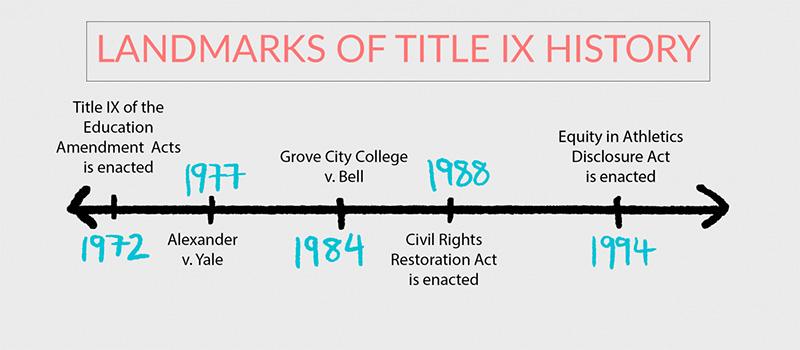
It’s easy to forget the storm surrounding the implementation of Title IX, but to colleges and universities…and to generations of women, its effect has been greater than a major earthquake…and far more lasting.
After nearly a century of racial degradation and decades of demonstrations, the landmark 1964 Civil Rights Act was passed, forbidding discrimination based on race.
That success emboldened feminists to insist on laws that promoted gender equality as well. Their efforts helped pass the Equal Rights Amendment and send it on to the states, where it lingered, never passed. Meanwhile, women urged Congress to pass laws adding gender discrimination to the Civil Rights Act. Hearings revealed the extent of the prejudices that existed toward women in upper-level academia: “You’re so cute, I can’t see you as a professor of anything.” “Why don’t you find a rich husband and give all this up.” “We expect women in our classes to be competent, we don’t expect them to be brilliant or original.”
In those years young women represented only 42% of college students and were discouraged from the more lucrative and emerging fields we now call STEM…Science, Technology, Engineering & Math. At the same time there were less than 20,000 girls participating in college athletics compared to nearly 300,000 boys. The same was true in high schools across the country.
In 1972 success! The Civil Rights Act was amended to prohibit gender discrimination. It didn’t take long to realize that including sports was going to be a problem. Numerous amendments were proposed to exclude sports but they were all defeated. After all, football and basketball brought millions into university coffers. At UCLA revenue from football and basketball supported 40% of the school’s athletic budget. At USC, it was nearly 100%. Women’s sports brought in nothing.
Under Title IX revenue would now make no difference. Sports programs for men and women were to be treated equally. Division 1 schools were allowed approximately 400 scholarships. If women were to get 200, and 85 were necessary to maintain a quality football program, some men’s sports would have to be curtailed. Colleges screamed. Boosters shouted. Pro teams that looked upon colleges as cost-free training grounds squealed. But the law held and by 1979 the government had established a 3-prong test for compliance: participation, benefits and treatment, and financial assistance.
The chopping began. Some schools stopped awarding scholarships to talented male tennis players or golfers. Others dropped swimming or water polo or wrestling. Meanwhile expanded women’s programs added soccer or golf, maybe water polo, and field hockey.
The results have been overwhelming. Today more than 110,000 women participate in college athletics at the same time women outnumber men in overall secondary education enrollment.
But the success of Title IX goes well beyond athletics, it speaks to the success of women in business and government. The attributes that one gains from academic study and athletic competition prepare one for the challenges and opportunities of life and those exist equally for both men and women.