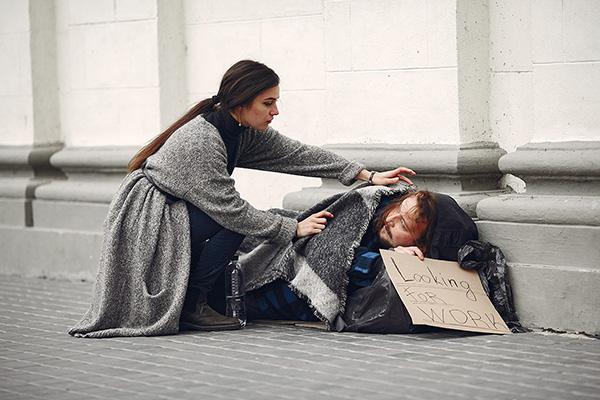
Somewhere along the way we have empathized on our way into a homelessness crisis. In Los Angeles County 10 million residents skirt around the detritus of nearly 170,000 homeless. New York City has nearly 100,000. San Francisco faces extreme threats to its quality of life. One out of five homeless people in our country call California ‘home.’
‘Yesterday’ it was illegal to loiter. It was illegal to sleep in public places. Old movies showed police rousting people sleeping on benches, on subways, or in public libraries. Where are the rights of those who are legitimately suffering? What are the rights of the majority who pass increasingly large, and aggressive, homeless encampments, often fearful of what they might encounter?
Shortly after the Civil War a law was passed that allowed people wandering around without a job or proof of a means of support to be jailed as vagrants. It was intended to return newly freed slaves to a life of servitude. Laws have typically defined a vagrant as one ‘who loiters or wanders from place to place without apparent reason or business, and who refuses to identify himself when questioned by a police officer.’ In more recent times those same laws have been declared unconstitutional as being unnecessarily vague and in violation of the 14th Amendment.
In the 1980s New York City implemented a ‘broken window’ policing policy. It averted that ignoring the commission of minor crimes led to a breakdown in society. It was better to deal with minor irritants before they festered into larger ones. Targeting vandalism, loitering, jaywalking, and public intoxication would increase the quality of life for the majority of citizens and, so, they proceeded. The policy cleaned up Time Square and allowed the popular tourist area to flourish but it also encouraged aggressive policing that often-targeted minorities and the mentally ill.
In California the problem first reached public consciousness in the 1960s when Ronald Reagan, then Governor, signed laws that stopped institutionalizing the mentally ill. The move was supported by both President Kennedy and the Supreme Court who all agreed that forced treatment of the mentally ill was illegal. Released into society, many who had been in these facilities committed minor crimes and were incarcerated. Between 1980 and 2006 the California prison population grew 6x…from 25,000 to 170,000, one-third of whom were dealing with mental illness. When Jerry Brown became Governor, he was forced to deal with mass incarceration and overcrowding in prison, many of whom were non-violent offenders. His solution…early paroles and a massive release of inmates.
The combination of these two well-meaning policies evolved into a surge of homelessness exacerbated by an exploding drug culture, returning veterans ill-supported by an understaffed, underbudgeted Veteran’s Administration, an exploding housing market, and communities closing their eyes to the problem.
Today there are more than 400 non-profits in California focused on the homeless problem. Half of them is in Los Angeles. Many of their names are familiar: Covenant House, Midnight Mission, Path, Hope of the Valley, Skid Row Trust. In addition, nearly 50 state agencies provide various levels of support including assistance for the more than a hundred thousand adults in the state considered ‘chronically’ homeless.
Today this amorphous group have voices to represent them. They have their own attorneys and support groups. They defend their encampments and way of life with zeal.
Los Angeles and San Francisco aggressively search for housing and shout ‘success’ when they get a few hundred souls off the streets. But that isn’t a solution…it is a gesture.
The homeless deserve better and so do we. We need to find an area where they can gather, take care of themselves, and feel safe…streets and sidewalks are not the answer.
I don’t have a magic answer, but I’d start with dedicating a large municipal golf course, installing mobile bathrooms, showers, and laundry facilities as well as mini markets. I’d make certain it was funded well to be properly policed, drug-free, and safe.